
I grew up as the youngest kid of a World War 2 Veteran, as such, my youth was spent paging through the history of the war in my dad’s collection of books. We were also a home movie family, so my dad would select all those old black and white war movies.
Some that come to mind are:
- The Dirty Dozen (1967): A group of convicted military prisoners are recruited for a dangerous, almost suicidal, mission against the Nazis. The film is known for its ensemble cast and action sequences.
- Battle of the Bulge (1965): Depicts Germany’s final major counteroffensive on the Western Front, exploring both the heroism and the harsh realities of the conflict.
- Where Eagles Dare (1968): Allied agents are tasked with rescuing a captured general from a heavily fortified German mountain fortress.
- Battle of Britain (1969): This film showcases the aerial battle for control of British airspace during the summer of 1940, featuring extensive aerial sequences and historical details.
- The Bridge at Remagen (1969): Based on a true story, this movie focuses on the fight to capture a vital bridge across the Rhine River.
- King Rat (1965): A black comedy about the survival dynamics in a Japanese prisoner-of-war camp, known for its grim humor.
- Is Paris Burning? (1966): This film chronicles the liberation of Paris by the Allies and French resistance fighters.
- The Night of the Generals (1967): A mystery that centers on a German general involved in a series of murders.
- The Devil’s Brigade (1968): Tells the story of a joint American-Canadian commando unit formed to undertake specialized missions.
The one that stood out to me though was “The Longest Day,” a highly acclaimed epic war film from 1962 that vividly portrays the D-Day landings in Normandy on June 6, 1944. It’s based on the non-fiction book of the same name by Cornelius Ryan, who also contributed to the screenplay. There were others, but my entire youth was an inquiry into World War 2. When I was about 12, I subscribed to Purnell’s History of the Second World War, a magazine I got weekly for 7 years. It was more comprehensive than my dad’s old books and the photos were in color. They also carried on after they were done reporting on the second world war, that they took on the Israeli/Palestinian conflict, and they reported on one or two others too.
Growing up in South Africa, you are schooled about the Boer Wars of course, and not far from where I lived was the Voortrekker Monument was constructed.
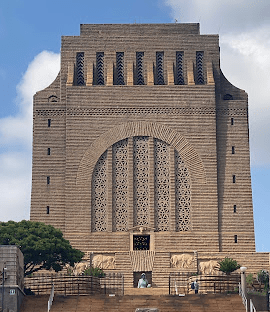
The Voortrekker Monument, located just south of Pretoria in South Africa, is a mammoth granite structure is located on a hilltop, and was raised to commemorate the Voortrekkers who left the Cape Colony between 1835 and 1854. You drove past it on the road to Pretoria from Johannesburg. Naturally, given that I was a gymnast and that the sport was dominated by Afrikaners, I learned to speak it pretty well, so on occasion as a teen, I got to talk to people who’s ancestors suffered at the hand of the British, which fed their resentment of english speaking folks.
In 1967, the Six Day War occurred. This was impactful to me, because our friend Howard, put his military gear and went off to Israel to join the fight. I had just started hebrew school then, and the topic of support for Israel was a really big push, so the 6 day war made an impact on me.
Being South African, I looked forward to going into the military once I got out of high school. It was one reason I joined the Cadet Band in high school. Funny story, I was so bad at the bugle, that I was moved to drums, so, I learned a little about drumming and marching. They were training us to be soldiers.
When I was 6, my brother went to the Army, and that was super exciting for me, his kid brother. I used to play with his helmet when he came home. I remember one day he came home on leave, and he brought his rifle with him, and he had live ammunition. My dad wanted to shoot it, so he took aim at the eucalyptus trees in the distance and took a shot. I just about jumped out of my skin. Another aspect of that memory is that we had crates of oysters and we spent the day shucking and eating oysters in the yard.
When I was about 14 years old, I picked up Radio Moscow on my short wave radio, and called my dad to come listen. “Listen Dad, they say South Africans are fighting Cubans in Angola!” My dad, being a good conservative pooh-poohed the report saying, “Those are communist’s! Don’t listen!” Well it turned out radio Moscow was correct. We were indeed fighting cubans in Angola. I knew this because I went to a gymnastics camp for a couple of weeks that year. The camp was located at the army barracks near Pretoria. Doing gym all day was taxing, especially in the African sun, so, in the evening when it cooled down, we were out horsing around making a bunch of noise like teenagers do, when this Sergeant Major in full dress yelled at us and told us to come over. We went to him to hear what he had to say. He said, (in Afrikaans) “These boys are just back from the war. Please let them sleep.” I asked him, “Where were they fighting?” he said, “Angola”. Well what happened soon after that was that both my brothers in law, Malcom and Rex, were called up to go fight. Malcom was an officer and a dentist, so he basically did dental work. He worked it out to keep Rex out of the front lines by making sure his dental surgery was still in progress. Very clever.
When I was 16, I got to go to Berlin on the South African Gymnastrada team. We stayed in the suburb of Spandau, literally across the street from Spadnau prison where Rudolph Hess was jailed. What I remember from that was how disciplined and big their German Shepard police dogs were. The highlight of the trip for me was going into East Berlin across Checkpoint Charlie. You really got the impact of the war, because while West Berlin was well built, East Berlin was still bombed out and looked pretty devastated. There were guards in pillboxes on just about every corner, and crossing was quite something, esp going back to the West. You walked across no mans land, barbed wire and high fences, and the East German border guards took their time with each of us going through every page of our passports and taking long intense looks into our eyes as we exited the East.
When we did out gymnastrada event, we did it in the Olympic Stadium. I remember standing outside the stadium waiting to enter with the other countries, noticing how fascist the building and statures were. I realized that this was where Nazi rallies had been held and my mouth was in my stomach. Walking into the stadium, there were protests against us being that South African had an apartheid government that the protesters objected to. Standing there in the stadium where Jesse Owens had humiliated Hitler was a treat. I recognized this at age 16.
Just as I was graduating high school, Soweto erupted and the war was in the streets. At the same time, I got called up to the Airforce, probably because I was a gymnast and the Airforce Gym in Pretoria was where I was called up. I deferred in that I went to college (Even though we had made the decision to leave South Africa by that time, in order to keep me out the army, I needed to go to university. After we left, each year the army sent me a letter making my call up progressively worse. By the end, I was to be cannon fodder in the infantry. Eventually, I renounced my South African citizenship and told them to fuck off. But, I digress.
When we arrived in America, the first memorable experience I had occurred as we went through immigration. The immigration agent went through the sheaf of papers we had signed and brought with us one by one. He came to the document that I had signed where I pledged myself to the army when enlisted. He looked up and said, “We don’t have a draft in this country.” and he tore up the document and tossed it in the trash. It felt like a 10,000 pound weight had been lifted off my shoulders.
Arriving in america soon after the Vietnam war was fascinating. As a nation, the general sense was that America did not celebrate losers, on the other hand, all the people I met who fought in Vietnam, were very much aware of the war in a different way. They were good guys who got badly treated by the nation. It was not till the Vietnam Memorial was built that America began to deal with the shitshow that was Vietnam.
There were a number of impactful Vietnam movies that framed my sense of the war as I encountered veterans of that war. They included Deer Hunter, Apocalypse now, Good Morning Vietnam, Full Metal Jacket, Platoon, We Were Soldiers, and Hamburger Hill to name a few. Those were the ones that impacted me.
The other thing that I was aware of as I arrived in the USA, was that the Cold War was very real. There were bomb shelter signs all over the UW campus where I was every day.
When I was a young adult, more recent war movies came out, movies like Tora Tora Tora and and Stalingrad. There were also the HBO show Band of Brothers and the sequel, The Pacific” that both left you with the impression that America and Britain won the war. The reality is that the war was really between Russia and Germany, while the US and Britain were involved in some battles.
As an adult I began reading a LOT about the war as the current histories published. I also listened to Hard Core History, both the WW1 and WW2 series, both of which are very compelling. While I enjoyed the Atkins series on America’s involvement in WW2, the book Stalingrad: The Fateful Siege by Antony Beevor to be the one book that gave a deep insight into the Soviet German war.
Living in America, I came to realize what a bloodthirsty country this is. Always quick to bomb and attack countries, where, but some bizarre coincidence, the population was always brown. (except for when Bill Clinton bombed Yugoslavia, but he also bombed brown people. That seems to be the American way.
If it was not crystal clear, when the US bombed and attacked Iraq because of fake evidence of WMD, I always wonder how many people died there and in Afghanistan because of American jingoism? Both democrats and republicans do this, so its not a party thing. It’s an American thing. Kill brown people. It goes way back into their history too. A nation founded on slavery is a racist nation.
My former Father in Law was a lifetime career officer in the US Navy. He was a Navy Chaplain, and only because he was a Marine, and there are no chaplains in the Marines. Bob was involved in WW2 in the Pacific where he earned 6 purple hearts and two bronze stars for valor. hi memoir is terrifying to read, but I did get a chance to chat with him about both Korea and Vietnam, where he served as a front line chaplain. He had a very hard time talking about the things he saw as a soldier.
My sense is that we live in a post conflict world now, where there is very little likelihood that nation states invade each other. Russia invading Ukraine being the exception in recent times. This is a very different world than it was in the middle of the 20th Century, and for me, I believe we should cut the military budget by about 80% if we plan to survive economically as a country.
 My Life: A Memoir