
My uncle Eric, who had moved with his family to Seattle after being recruited by Children’s Orthopedic Hospital (now Seattle Children’s Hospital) became a US citizen and applied for Green Card status for us. The riots had been ongoing for a couple of months when we had a family meeting, and there was no end in sight. At that point, mom and dad had been to Seattle the year before and fell in love with the city, my sisters Susan and Carol were both married to Rex and Malcolm respectively, and because both had English passports, they were going to head to England. My brother Derrick lived in Capetown, and was thinking of leaving the country too. I had received, with Eric’s assistance, an invitation to do gymnastics at the University of Washington. So I was committed to leaving the country too. My mom wanted to go be with her brother who she was very close to, and my dad was not having a great go of it in Johannesburg after his business failed, thought “why not?”. We took a vote and unanimously agreed to make our way to the United States.
We had tea with my Aunt Helen Suzman, who was the only Progressive member of Parliament, and she told us that she was privy to the plans that the government had to commit genocide if things got out of hand. Those were dark days. She said “I can’t leave, but if you can, you should.” With her blessing, we set about making application.
You have to get that in addition to being in a revolution, we were on a larger scale, in the middle of the Cold War at the time. There was fear of the domino effect of communism taking over Africa. There were communist insurgent movements in Mozambique and Angola, both former Portuguese colonies, Mugabe was turning Rhodesia into a fascist state and was confiscating farms of white farmers. One of my high school buddies, Mike Cowan, was a Rhodesian ex pat. The ANC was partly managed by and aligned with the Communist party and that was all wrapped up in the fear that the government played on. The South Africans fighting Cubans in Angola was really a proxy war between the CIA and the KGB. So all of this was the backdrop of my final year of high school.
The matric exams were brutal. There was a lot of stress. You went into the hall, where desks and chairs were assigned. You were allowed to have a pen and a pencil and a ruler, and a slide rule for math. Thats it. All the work you did to work out problems before you answered were to be in blank workbooks that they handed out. Then you turned everything in. I wrote pages and pages and pages. Once the exams were over, we were done. No more school.
Before the matric exams at one of our final assemblies, several kids rigged the speaker system to play Alice Cooper’s “School’s Out” loud and the entire song played. We were pretty care free.
I remember only one thing about the graduation ceremony. The speaker gave us the best advice. He read Robert Frost’s poem “The Road Not Taken” and he implored us to follow that advice….I have had that poem in mind since then.
The Road Not Taken by Robert Frost
Two roads diverged in a yellow wood,
And sorry I could not travel both
And be one traveler, long I stood
And looked down one as far as I could
To where it bent in the undergrowth;
Then took the other, as just as fair,
And having perhaps the better claim,
Because it was grassy and wanted wear;
Though as for that the passing there
Had worn them really about the same,
And both that morning equally lay
In leaves no step had trodden black.
Oh, I kept the first for another day!
Yet knowing how way leads on to way,
I doubted if I should ever come back.
I shall be telling this with a sigh
Somewhere ages and ages hence:
Two roads diverged in a wood, and I—
I took the one less traveled by,
After the exams, I took off and went to Europe to see my friends. I had a Euro-rail pass, a few hundred dollars in my pocket, a couple of places to stay in England and in Austria, so I took off from the South African summer to the bitter cold of the Western European winter. It was shocking….
I arrived in London and stayed in a youth hostel. I saw my cousins Alan and Revely and our friends Colin and his wife Linda who put me up.
I explored London and fell in love with the city. I saw Arsenal play Newcastle at Highbury, and was so happy. I pretty much spent all my money so I buggered off to Europe. In Europe I went first to Paris where I got horribly lost then onto Geneva, then Grunewald and then Zurich. I stayed at a youth hostel in Grunewald that was closed, but since I knocked on the door and had nowhere else to stay, he let me stay there. I wore everything I had and kept the light on and used all the blankets there were …it was still freezing…In Zurich I met Suzi Schmid the cousin of a high school classmate, and I purchased some snow boots. I went off to Austria to meet Barbara and Suzi and Gunther. It was so great to see them. Barbara and Suzie were beautiful and wonderful people and Gunther was an amazing skier. They took me sledding and skiing and I failed at both, but we had a blast and we continued to stay in touch.
When I came back from Europe, I had matriculated and I started at the University of the Witwatersrand or “Wits” (pronounced “Vits”). I was only able to get into the College of Education because of my grades. I mostly hung out with my friends Errol and Eddie and Ruth. We were thick as thieves. We did everything together. Errol and Ruth had an on again off again love affair but we were all good together. We even took a trip to a mountain resrort in the Drakensberg together.
Errol went to the Yeshiva College and played on their soccer team. I was playing for the Arts and Sciences College team at Wits. We were a good side, and several of our guys played for the University side that was promoted into the National First Division of professional soccer a year or two later. Anyway, Errol’s team made it into a cup final and he asked me to come play for them that game because they were short handed. It turns out to be one of my all time favorite games. There was a big crowd, about 5 deep all the way round the field. We were playing in yellow/orange jerseys and the other team was in blue. A late game situation occurred when Errol, who was a good dribbler, took the ball down the right wing. I trailed him as he got into the other half. He was confronted by two defenders and I called for the ball. He back heeled the ball to me and I looked up to see David, a tall blond kid in the penalty area in good space. I hit a curling cross with pin point accuracy and he rose above the defenders to thump a perfectly timed and placed header into the near top corner. The crowd erupted. David and I were mobbed by the players and the fans. It took a minute to clear the field and the game restarted. After two minutes the ref blew the final whistle and we were Champions!
At university I took classes in Economics, Biology, and Human Anthropology mostly for shits and giggles because our Green Cards had come through and we had committed to leaving in September so I could arrive in the USA in time for the start of the school year at the University of Washington.
So while I was at University, I mainly worked with a magazine called “CRISIS!”. The premise was that there were atrocities occurring in South Africa all over, but they were not being reported widely. For instance, there might be a column inch in a local paper that said “Black woman killed by white farmer” and a short paragraph about it. That story would never get widely reported, and it was happening all over the country. The editors pulled all of those kinds of reports together into one 8 page magazine that we distributed around the city. I was involved in distribution. The paper was banned and the editors and publishers were disappeared.
When I went to get fingerprinted by the police for our Visa application, the cop said to me “We know who you are. Get a one way ticket”.
I went to class to hang out with my friends and to get a taste of university life, but it really was a break from reality. Mostly I just goofed off, went to parties, played golf, and fooled around with the girls I was dating, and I also worked on distributing the CRISIS magazine and I got involved with the RAG committee. Rag was a parade that the University Students ran through the streets of Johannesburg to raise money for charity. All the students would get dressed up in crazy costumes and they would parade around on these elaborate floats throwing candy at the kids and collecting small change from the observers. It was fun, and a really good cause.
With months to go before we left, my dad and I worked out a month long vacation in the bush at my Uncle Ernie’s place near the game reserve. My dad and I went with Ernie and Harold, riding range rovers to the farm once we got to the gate.
Gong to the bush meant there were going to be guns.
Guns were ever present in the culture. My friends all had pellet guns and by the time I was 16 many had more powerful rifles. Most of us hunted. I had not had the experience of hunting until I went to the bush with my cousin Harold and my Uncle Ernie and my dad. Ernie was an amazing man. He had suffered polio as a kid and had one gimpy leg. But he never let that interfere in his life. We went boating with him at the Vaal River and he took me and Harold to Mozambique one year to go fishing in Baseruto. We had to dig for a little crustacean called Gafoof to use for bait. One time Harold and I were walking through the forest by the beach and we came across an old man who looked sad and hungry. He rubbed his belly and asked in Portuguese for food. All we had between us of any value at the moment was a coin worth about 25 cents. I offered it to him and he indicated that he could not eat it by biting on it. Shaking his head, he walked off. It was really sad.
Anyway, Ernie had this land he called his “farm” up on the border of the Kruger Park. He had built a house on the top of a hill literally within site of the fence to the park. The fence itself was a 3 strand barbed wire fence about 6′ high. We had to take Landrovers over pretty rough roads to get into the area he called his “farm” where his house stood. What was amazing about his place was that he had built a self filling watering hole, a pond really, down below the house so you could sit on the deck and watch the animals come and drink during the dry season.
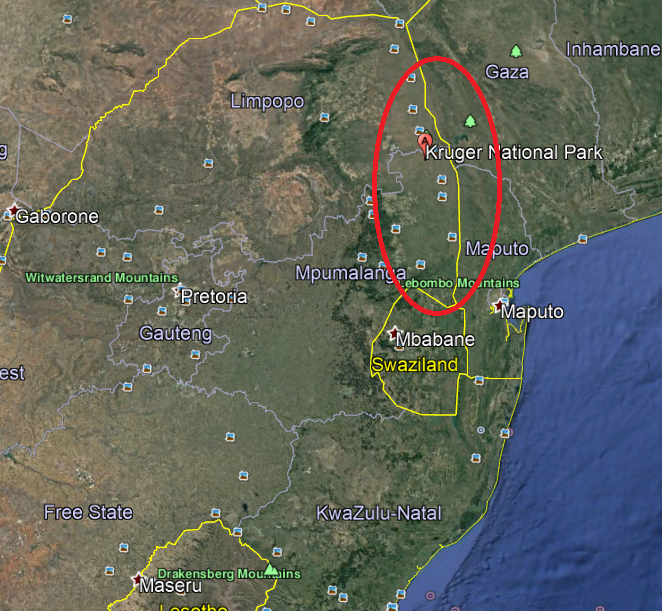


The most incredible experience Harold and I had, was a moment that I will never forget.
Harold and I went down in the Landrover to the dry river bed nearby. Ernie had a team of men digging river sand out of the river bed to bring up to the house in order to fill in around the pool he had recently installed.
Harold and I were armed to the teeth. We had buck shot, snake shot and an elephant gun, a 458 rifle.
We parked the vehicle and walked the 30 or so feet to the rivers edge to greet the workers and ask if they needed anything. They were about 10 feet below us digging sand and loading it into a truck and so could not see behind us. We chatted with them a few minutes and then turned to walk back to the Landrover.
We froze.
Under a tree, no more than 30 feet away was a pride of about 12 or so Lion just sitting and laying around under the tree. it looked about like this…
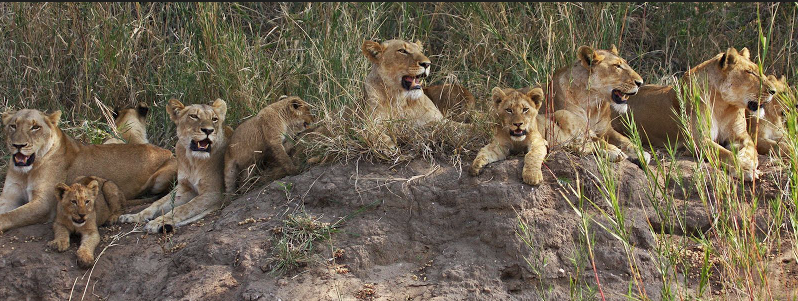
My heart started pounding and I stopped breathing. The lion looked calm and non-threatening, but I said to Harold “don’t make eye contact, walk slowly and confidently to the Landrover…shaking in our boots, we made our way to the car. As we walked away I called down to the men in the river bed “Lion!” (they scrambled for the truck). Harold and I laughed as we drove back….What was incredible about that walk back to the Landrover was that the lion had passed between us and the car. We could tell because their spoor were present…they had literally passed 15 feet away from us and we never had any idea.
Another scary moment at the farm was when we spotted a Black Mamba in the tree by the house….Scary because the Black Mamba is nominated as the most venomous snake on earth.
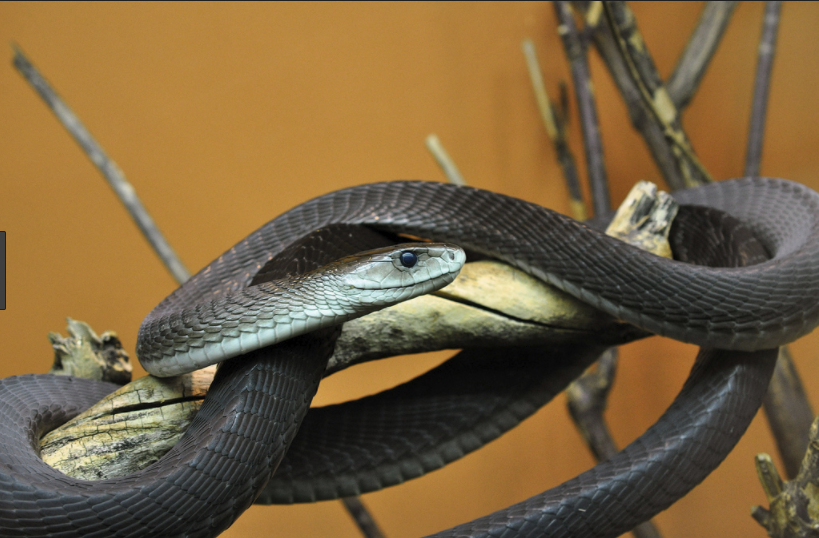
Ernie shot it with snake shot and the laborers cooked it up and ate it. I never got to taste it though.
Anyway, one day (we were there about a month) Ernie said “Lets go get an Impala!”.

We loaded into the Landrover and the servants came along behind in a flatbed. We drove for a while till we spotted a herd not too far away. We parked and using the hood of the car as a rest, Ernie shot a buck with a single well aimed shot. The workers raced out into the field, cut its throat to kill it for sure and dragged it back. We loaded it into the flatbed behind and headed back to the house.
There we butchered the animal and hung it to age for a week.
We then made the best venison Stew and ate like kings the rest of the time we were there.
I had a moment of authenticity with my dad one evening. We were drinking heavily for me really, (I had only been drunk once before when our high school prefect class had gone to a pub with Mr. Collins on a weekend trip where I got shitfaced) and the national drink Cane, Lime and Lemonade (Cane Spirits are like Vodka, and by “lemonade” they mean “Sprite” which we called lemonade) was brutal. Ernie, who had massive arms since he walked around of forearm crutches, challenged me to an arm wrestling contest…it was an epic battle that I won in the end (I was pretty strong in those days). My dad was drinking and cheering us on along with Harold.
My dad was as drunk as I had seen him…and after the battle he said to me …. “are we doing the right thing?” meaning leaving the country for Seattle.
I had made up my mind I was leaving. I was facing 5-10 years in the military, which meant fighting to defend the White Supremacist government of the time. I had no intention of staying and defending the apartheid government. But for dad, I can see now, at his age, which is about how old I am now, that it would have been a big risk, and very scary.
I told him “yes, definitely!” but I could see that he was doubtful.
The next day, Harold and I were sitting on the deck watching a large Kudu Bull surveying the fence. The three strands of barbed wire topped out at about 6 or 7 feet. This Kudu wanted to get to the water hole (it was the dry season). He stood there for a few minutes looking and then suddenly he leaped from a standing start, cleared the fence and went to the water hole. It was amazing to see an animal that weighed over 1000 pounds clear the fence from a standing start.
After I came back from the Game Reserve, I almost immediately went to Cape Town to spend a month with my twin cousins, Cindy and Shelly, a couple of sexy twins a year older than me, and their big sister Lynne and my Aunt Iris.
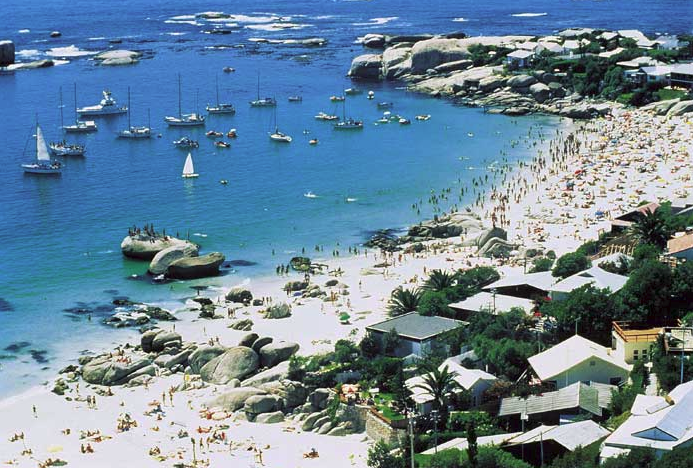
It was magical. We stayed on Clifton Beach in a swanky apartment on the cliff and we had a blast. We took a weekend and went to Umhlanga Rocks where the people who’s home we were staying in had beach cabin and a dune buggy.
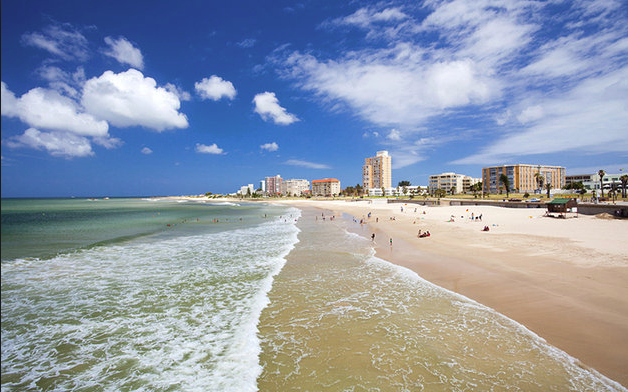
A month in the bush and then a month at the coast made me love South Africa in a way that I really never had before then. As a result, I left the country with some fresh regret.
We packed our possessions into a container. We gave a lot of our things away. We said our tearful goodbyes and we left on an adventure.
First stop, London, England!
Destination, Seattle, WA in the good ole USA!
Some Thoughts on Living in and Leaving South Africa
Living under apartheid in South Africa as a kid was a little confusing. As a youngster, we had servants Rebecca and Abbiott. Rose used to do the ironing. Rebecca often had her kids staying and I played with her kids till I went to school. I don’t remember their names and I never saw them again.
Everybody had a servant or two. There were lots of African men and woman in the white neighborhoods, and I learned later that in order for them to be there, they had to have their “passbook” – papers – in order.
I also saw police, white and black, arresting, almost exclusively, black men for no apparent reason (usually their papers were not in order).
Whites had red buses, blacks had green buses. Red buses often had a conductor collecting tickets and there was always a seat…the buses were mostly empty. Green buses were crowded. There were fewer of them, none were double decker, and there were fewer stops where they gathered which meant that people had to walk miles to get to and from work.
Amenities throughout the city were segregated. Drinking fountains, toilets, movie theaters, restaurants etc. I remember when I worked as a waiter at Mr. Steak and all the kitchen staff was black…every single person. Not one black person ever ate in that restaurant.
There was a palpable fear of black Africans among white people. I remember one time when my dad was lost on the way to the game reserve. I was in the back of the car about 11 years old. He stopped to ask a respectably dressed African man directions. The man made an effort in broken English to explain. My dad was having a hard time following. The man said “I can show you” and instead of letting him get in the car, my dad simply gunned it and took off. I asked him why he didn’t take him up on his offer…he said nothing.
I got to go to Soweto one time in my life. My uncle, Anthony, was making a movie for a black audience and there was an on-location set where they were filming that John and I were invited to. I got to help hold the microphone boom…which made me a Grip for the day.
The experience was interesting. The part of Soweto that we were in was made up of small seemingly well kept houses. Not middle class by my standards of the time, but certainly not the tin shanty town that Alexander Township was. You could drive by Alexander Township and see it from the highway, and it was really poor.
The Africans were tribal, and there were lots of languages…the most common, Xosa, Zulu. and Bantu – and in addition to speaking several languages, African’s often also spoke English and Afrikaans. We used to go to the mines to watch tribal dances from time to time. It was a nation of so many cultures. There were all those African tribes, and there were the Cape Coloreds, and the Malays, and the Indians, and the Afrikaners and of course, the English…and then there were also Chinese and Japanese immigrants too.
Nelson Mandela was a mythical leader to most white South Africans. he had been in prison for most of my awareness. But Robben Island where he was in prison became known as Mandela University. In fact, the prisoners, many of whom became South Africa’s leaders, used the formation of a football club, Makena FA to formulate the government in exile.
Ghandi was the source of inspiration to Mandela and also Steve Biko, who was one of the founders of the Black Consciousness Movement, which had started holding sit down protests. Peaceful, non- violent activism. Well the weekend I left the country, Steve Biko was arrested, tortured and murdered.
With all the unrest and institutional racism, and the coming civil war where I would have to defend white supremacy, I was relieved to be leaving that place behind. At one level I was glad to leave and at another I wanted to see justice. In the end, I admit that It was a relief to get on that plane and have it take off.
I am from South Africa, but I did not align with Apartheid at all, and I was glad to be leaving.
London, England
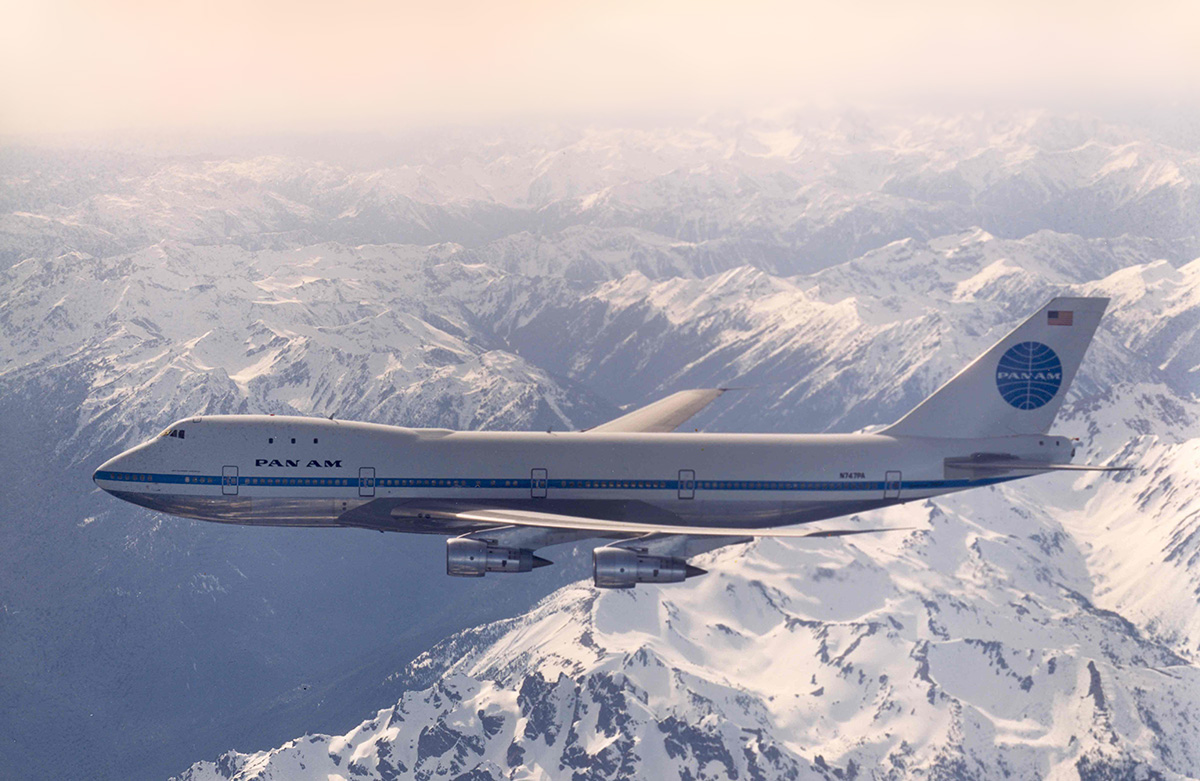
We left South Africa on September 1st 1977. We arrived in London and spent the weekend seeing our cousins and touring the city. I made my way to Highbury to watch Arsenal play Southampton with my cousin Mandy, who happened to be in London at the time. We connected with our cousins Alan and Rev, and Ian and Janice before we boarded the Pan Am flight across the North Pole to land in Seattle. It was a spectacular 9 hour flight on a Jumbo Jet.
 My Life: A Memoir